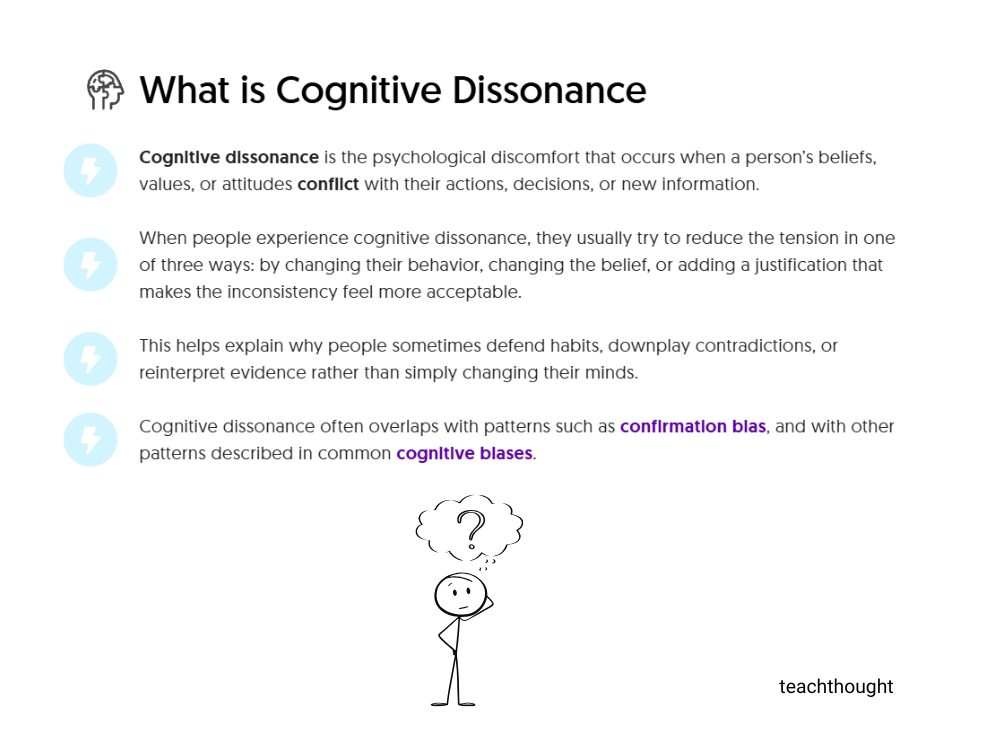
Cognitive dissonance is the psychological discomfort people feel when their beliefs, values, or self-images conflict with their actions, decisions, or new information.
Explanation
Cognitive dissonance is a theory in psychology that describes the tension that occurs when a person holds inconsistent beliefs, or when behavior conflicts with stated values. That discomfort often prompts the person to reduce the conflict by changing behavior, revising beliefs, or adding reason.
Main Symptoms of Cognitive Dissonance
- It involves felt a mental discomfortnot just an argument on paper.
- It is often seen when an action, belief, value, or ownership claim is inconsistent with some other important understanding.
- Discomfort tends to be stronger when the issue is important to the person or affects the way they look at themselves.
- People are often motivated to reduce tension quickly, but not always rationally.
- Adjustment may involve positive change, but it may also involve defensiveness, distortion, or rationalization.
How Cognitive Dissonance Often Occurs
1. A conflict arises
A belief, value, or self-image conflicts with a behavior, decision, or new knowledge.
Example: A student believes that honesty is important but cheats on his assignment.
2. The discomfort is palpable
Incongruity creates internal tension such as discomfort, guilt, defensiveness, or pressure to explain the discrepancy.
Example: The student sees the behavior as inconsistent with being an honest person.
3. The answer follows
The person tries to reduce discomfort by changing behavior, changing belief, or adding forgiveness.
Example: The student stops cheating, redefines the act as “not really cheating,” or says the assignment was unfair.
Three Common Ways People Reduce Cognitive Dissonance
1. Change behavior
A person brings actions into better harmony with stated beliefs or values.
Example: A student who believes that cheating is wrong stops using unauthorized help on assignments.
2. Change the belief
One revises the original belief to make the conflict sound less serious.
Example: A person who values health but continues to smoke decides that health outcomes are largely determined by genetics.
3. Add accountability
Someone introduces a new explanation that makes the disagreement sound reasonable.
Example: A student who cheats thinks that the assignment is wrong or that everyone else is doing the same thing.
Examples of Cognitive Dissonance
Academic Integrity vs. Academic Conduct
“Cheating is wrong. Academic honesty is important.”
A student copies homework, uses unauthorized AI or online help, or shares answers during a test.
The student thinks he is honest but behaves dishonestly. That discrepancy creates discomfort because the behavior conflicts with moral standards and your preferred self-image.
- Change behavior: stop cheating and complete future work independently.
- Change the belief: redefine the act as “just getting help” rather than cheating.
- Add accountability: they say the quota was unfair, the pressure was too high, or everyone else is doing it.
Health Values vs. Daily Habits
My life is important. Healthy eating, sleep and exercise are important.
The person repeatedly eats poorly, sleeps little, skips exercise, or uses substances that conflict with those goals.
A person values life but behaves in a demeaning way. Discomfort comes from seeing a gap between stated values and repeated practices.
- Change behavior: improve processes and reduce harmful practices.
- Change the belief: decide that life is beyond one’s control anyway.
- Add accountability: say stress, lack of time, or current demands make the behavior understandable.
Financial Responsibility vs. Spending money
“Being financially responsible. I have to save and avoid unnecessary debt.”
A person makes repeated purchases, carries avoidable credit card debt, or puts off saving while saying financial discipline is important.
A person sees themselves as financially responsible, but behavior suggests otherwise. The resulting tension arises from the conflict between identity and evidence.
- Change behavior: budget carefully and limit discretionary spending.
- Change the belief: decide that saving for the long term is less important than enjoying the moment.
- Add accountability: position purchases as rewards, exceptions, or necessary stress relief.
Personal Principles Against Unfaithful Behavior
Honesty is important. I want to do the right thing even when it gets in the way.
A person lies to avoid consequences, to take credit for someone else’s work, or to remain silent after doing something wrong.
Discomfort comes from seeing a direct conflict between one’s behavior and actual behavior. One wants to think of oneself as moral, but morality points in the other direction.
- Change behavior: tell the truth, accept the consequences, and correct the action.
- Change the belief: decide whether minor infidelity is normal or harmless.
- Add accountability: they say there was no real choice, the situation was wrong, or a lie prevented a worse outcome.
Related Concepts
Why Cognitive Dissonance Matters in Learning
- It helps explain why people sometimes reject evidence that challenges their beliefs.
- It explains why self-forgiveness can interfere with reflection and decision-making.
- It supports instruction in critical thinking, metacognition, and mental humility.
- It helps students explore the gap between what they say they value and how they actually respond.
References
Festinger, L. (1957). Cognitive Dissonance Theory. Stanford University Press.
Harmon-Jones, E., & Mills, J. (Eds.). (1999). Cognitive Dissonance: Advances in Critical Theory in Social Psychology. American Psychological Association.
Aronson, E. (1992). The Community Animal (6th ed.). WH Freeman.